
30 Years of ATLiens, Post-Truth, and Afrofuturism Gone Awry: Atlanta is Atlantis?
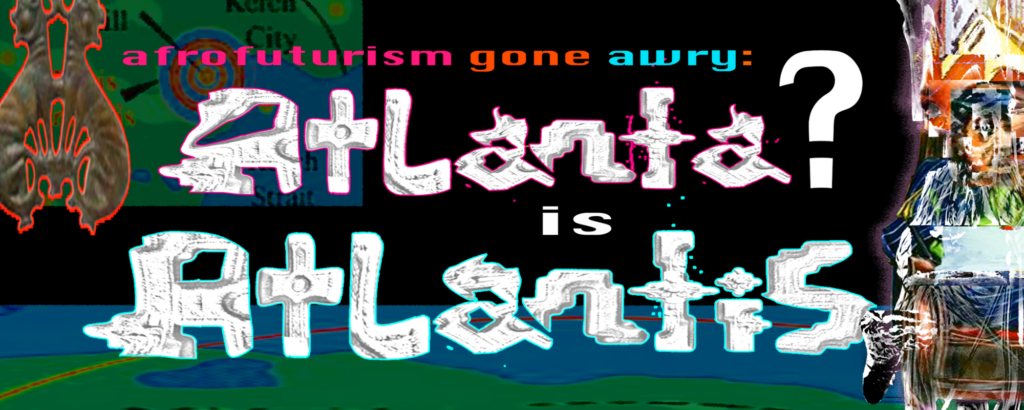
Design by Addy Russel
By Christian JOnes
They gathered together atop Stone Mountain solely to summon an energy vortex that would resurrect the spirit of Atlantis. “Atlanta is Atlantis, Atlanta is Atlantis,” they chanted seven times in unison, to “keep the frequency high.” There looked to be about 80 to 100 people, mostly black—one holding a golden scepter up into the sky, and at least two others staffs. “All heed the legendary, Indigenous ones!” yells a man leading the crowd. “That’s right!” a voice in the crowd calls back. On August 26, 2025, @insideatl posted a TikTok of a group of people who believe the landlocked city of Atlanta, Georgia is actually the mythical lost city of Atlantis. They call themselves the “Black Atlanteans.”
Three months later, the legendary Atlantan rap duo, OutKast, were inducted into the Rock & Roll Hall of Fame. It was 30 years after the duo wedged the South right in the middle of what had been an exclusively East coast-West coast battle. At the 1995 Source Awards, the two accepted their award for Best New Rap Group, and André 3000, who hadn’t yet adopted the “3000,” famously let the world know that the “South got something to say.” The next year, on August 27 of 1996, the world would hear what exactly the south had to say. With the release of their sophomore album, ATLiens, the rap duo would become the progenitors of an otherworldly legacy—one that seems prophetic even on its 30th anniversary.
On ATLiens, OutKast fully peacocked. Take one look at the comic book-inspired cover—a full three years before the mask wearing Madvillian, MFDOOM would release his first album—and it was clear this was some new shit. The “ATL” in the title honored their home soil and the (A)“Liens” because that’s what they were: the flow-too-different outcasts of the American rap scene. ATLiens was one of Atlanta’s earliest nation-wide articulations of cultural identity. But as much as OutKast were of the land, they were, true to title, estranged, observing. André 3000 was freshly sober with new spiritual interests, donning eclectic outfits and colored prints. Big Boi had just become a father and was feeling the loss of his aunt Renee. As Jeff Weiss said in his Atlanta to Atlantis: An OutKast Retrospective in Pitchfork, that mix of spirituality and sobriety, escapism and realism became the secret spice for their cornbread.
Some playful self-mythology opens the music video of the titular track, “ATLiens,” told in a tongue-in-cheek tracking shot of hieroglyphics. A flame ignites and the deep soul-funk groove kicks in. The track, like the rest of the album, is a perfect blend between thump and thunk—playful, catchy musings alongside hard existential questioning. André 3000 dishes you some food for thought, “They alienate us ’cause we different keep your hands to the sky/ Like Sounds of Blackness when I practice what I preach ain’t no lie/ I’ll be the baker and the maker of the piece of my pie.” Then the chorus beams in so catchy and weird that it draws you into its semi-ironics: “Now throw your hands in the air/ And wave ’em like you just don’t care/ And if you like fish and grits and all that pimp shit/ Everybody let me hear you say, “O-Yea-yer.” Their particular flavor of Afrofuturism was never too far off, but that perfectly genius melange of respect for tradition and cool iconoclasm.
Three decades later, a new-age group adjacent to the Black Atlanteans called the University of Cosmic Intelligence (UCI), takes self-mythologizing to its furthest extreme—without a drop of irony. The group is led by founder Rashad Jamal, a self-proclaimed prophet who calls himself Divine Insight. Jamal is one of the more popular of a vaguely related network of spiritual influencers having garnered beyond cult-status online followings—over 128,000 on Instagram, almost 176,000 on Tiktok (before it was deleted), and 75,000 on YouTube. Jamal claims that Atlanta is the capital city of the ancient realm of Atlantis because it lies on the 33rd parallel and because ley lines are the veins of the planet.1 Rashad and the UCIs believe that the ley lines currently function as energy sources for an anonymous “them” to cast spells and jinxes on black people, specifically Atlantans, in order to suppress their life power. Apparently, there’s been a magical war taking place all along, but instead of “light” and “dark” abstractly signifying forces for good and evil, Jamal is talking about race.
Jamal claims to be a god sent to Earth to heal the planet, and that Black and Latino people are gods incarnate, whom he refers to as carbonated beings. He believes that his soul mission is “to enlighten and inform and increase the frequency of the planet, and to rid this planet of its parasitical invaders”—namely, white people. Jamal founded UCI as a “school,” where he would teach followers about the truth: that Earth is actually the planet Ki and that they are his Grand Cosmic Rising Family. Jamal also uses the UCI website to promote his 2022 album Only The Real Gone Relate, released under the artist name Jeda_music. The opening track, “The Landing (Intro),” sounds like the intro of “ATLiens”; there is a third person narrator giving the low down on a far flung conspiracy about planet Ki, reminding Jamal that he alone can teach his followers to salvation. “We young, black woke, and violent, motherfucker,” Jamal mantras on the leading single “Kundalini Energy.”
Jamal is now in prison on a 40-year sentence. Not for his outlandish claims, but for molesting his ex-girlfriend’s daughter, along with a list of previous charges against him. Despite this, he continues to influence his followers through social media. Following his arrest, several of his devotees have or gone missing or themselves been arrested—the result of confrontations with police or others over their beliefs. On January 16, 2022, in Alabama, 25-year-old Damien Washam killed his mother with a katana. Jamal’s imprisonment has generated new conspiracies from other disciples, who insist that his case was manufactured to dim his truth-to-power preaching. But the zealotry doesn’t stop there. An online petition seeking his release garnered some 9,000 signatures. You have only to look at the comments of one of his posts to see his support.
Other accounts have built off these theories. Instagram account @originalblackgod (574k followers as of August 2026) repurposes these claims in a hyperreal AI sheen—some of whose videos Erykah Badu, longtime affiliate of the Dungeon Family group and mother of André 3000’s son, Seven Sirius Benjamin, has liked. These reels, made with the AI video generating platform Veo 3, are narrated at times in what can hardly be called “rapping” and at others by a voice that recalls the gentle huskiness of old PBS documentaries. They are cinematic re-imaginings of “history,” and the rabbit hole is endless: Black Indigenous Atlanteans, the “true giants of history,” (yes, actual giants) are also the true indigenous “owners” of America. Los Angeles, San Francisco, and New York are all ancient cities built by Black-Indigenous civilizations that lasted for thousands of years, until they were destroyed and erased from history by white settlers. Tesla was not one man, but a collective of black minds whose work was twisted, hidden, and distorted to feed the machinery of capitalism. The Olmec Mayans were actually Africans who walked across a land bridge during Pangea. Chicago is Mecca. Don’t forget, NBA players are robots and the government is manufacturing the weather.
Shockingly, the comments are all praise. “I truly believe it was like this for real.” “I seen this in a dream.” “Now that’s a good use of AI.” “Damn…the original Wakanda?” And perhaps the best (or worst depending on who you ask): “This is dope! This is why I homeschool. These are the images my kids will be first shown about our people.”
Jamal’s self-proclaimed God status is actually not so different from cosmic philosopher, poet, and composer Sun Ra’s origin story. Born Le Sony’r Ra, he said aliens visited him and told him that he alone was fit for space travel, so they beamed him up to Saturn and taught him secrets that would liberate him from the confines of human existence. He was to spread his message in times bereft of hope, and in the 1950s, amid threats of nuclear war, militarized liberation movements, and the space race, Afrofuturism was born. In his early album notes and interviews, Ra began iterating an “Astro-Black mythology,” which connected the history of ancient Egypt to the promise of a human flight “beyond the stars.” He believed that the traumas of human history, especially the Atlantic Slave Trade, had made life on Earth unsustainable. It was only through futurist creation that black people could usher forth that ancient promise of the cosmic flight.
The original premise of the movement was its emphasis on radical imagination and community liberation by harvesting the good from the past and envisioning better futures. Save for the spiritual branch of Afrofuturism that took its liberties with the limits of fact—linking liberation to the enlightenment of consciousness—the movement never really lost track of its “speculative” nature. Black artists manifested new dreams, aesthetic styles, and imaginaries into actual concrete existence—take George Clinton’s P-Funk Mothership for example. Even the subgenre of “Alternate History,” in which an author imagines how the course of history might have changed if one historical event had an outcome different from the real-life outcome, was consciously speculative. The only difference now with the UCI is the collapse of that line between remembered and imagined, between real and counterfactual. When people comment things like “I didn’t know why I cried when I saw this…Perhaps it’s because I remember?” they show that it isn’t so much a creative or playful rendition of the past, it is the past. Reality itself seems to have collapsed upon the imaginative fervor of the present. It’s a vein of Afrofuturism that has gone haywire.
These post-truth AI deepfakes, as convincing for the media-illiterate as the shadows in Plato’s cave, echo and evoke actual lived struggles. They deliver impassioned sermons, speeches about identity and birthright, about skepticism of a history that has been all too one-sided and disempowering, about the importance of seeing yourself as worthy in a world that seeks constantly to dim your light—or whiten your darkness. But in other ways, the videos actively erase struggle and identity, and along with them all of the real, alchemical achievements and ingenuity that Black people have transmuted from struggle. One AI video, to the beat of Kendrick Lamar’s “Alright,” claims that the “confederate flag…ain’t never been about slavery or hate, that’s the Indigenous alliance symbol. We were a cosmic confederacy, star-travelers not slaves, these are facts they hide. That X on the flag, that’s the X on the planes crossing over, real dimensional science, we wasn’t just physical, nah we was Cosmic. We were the original confederate soldiers.” It reads like schizo-spiritual neo-nazi propaganda, taking the most obscure routes to the most inane conclusions. Worse, given that the videos are AI generated, they are complete regurgitations of readymade aesthetics—all the videos look like Tubi parodies of fantasy franchises like Game of Thrones, Star Wars, and Marvel, projected through the glitchy, give-your-computer-a-virus backdoor of 123movies. There is no soul in these radical delusions; proponents are fed their daily bread through an algorithm. With ever-mounting concern about social media psyops, it doesn’t feel far off to wonder if there’s an ulterior motive somewhere in this heap of broken images.
Mythology is the most ancient form of human storytelling and acts as a sacred facet of identity, encompassing the values, knowledge, and traditions of a group of people. It makes sense that when faced with a history so burdened by terrible events, when a history was even recounted at all, a new mythology would offer a sense of rootedness or promise a brighter future. But what is overwhelmingly lost in current veins of new-age escapism and erasure is the real, heavy weight of lived experience. A lived experience that is taking place now, in the inescapable present, and it does have consequences. Consciously or not, these AI videos leave lived experience and struggle behind or write them off as illusions, making a paean to grand narratives.
Times are certainly bleak now, but perhaps they have always been. OutKast released ATLiens, during a time when working class voices in Atlanta were being pushed aside. The same year it dropped, city officials were trying to portray Atlanta as an “utopia” because of the impending 1996 Olympics. André 3000 and Big Boi were themselves coming to terms with their newfound celebrity status and the realities of their lives that success hadn’t quite shaken. It was their genius to hold these ironic tensions together without flattening either one, oscillating between humor and gloom, criticism and self-criticism without dropping a beat. Take the minute-long solo of squeaky morse code closing out “Wheelz of Steel,” as chaser after André 3000’s bitter-pill bars of “cod liver oil.” Then there’s the lead single “Elevators (Me & You),” with its austere instrumental, André 3000 trying grimly to ground his mounting success in the fellow man’s struggle: “I live by the beat like you live check-to-check.” The closing track, “13th Floor/Growing Old,” opens with a spoken-word sermon from Big Rube about bad faith: getting yin and yang confused, doing everything except what will bring success and prosperity (nevermind his embarrassing disavowal of gay rights). It isn’t completely puritanical though; spacey bubbles float above church chords and record scratches, samples of Debra Killings’ gospel chime in. It’s an existential meditation on aging, home, consequences, transcendence. André 3000 closes out the album with a sentiment as axiomatic as a fable, but delivered with a lyrical genius that only OutKast could pull off: “Fat titties turn to teardrops, as fat ass turns to flab/ Sores that was open wounds, eventually turn to scab/ Trees bright and green turn yellow-brown—Autumn caught ’em/ See, all them leaves must fall down—growin’ old.”
At their weirdest and most surreal, OutKast made their peace with the discomfort of the present. Perhaps they only had to match its frequency. Moments of hedonism are tempered by an aversion to spiritual hollowness, while almost every finger pointer outward feels pointed back at themselves. Moments of sexism sit awkwardly alongside their feeling of optimistic kinship. But the duo brought a feeling of fantastic possibility to their present like the first rain after a drought. Repeated like a mantra throughout the album, Big Boi says “’96 ’gon be that year.”
In the wake of ATLiens, other Atlanteans have emerged. The Atlanta Aliens ABA Pro Basketball Team named themselves after the album. An EDM duo tried to steal the album title as their name. The Futurama episode “The Deep South” (2000), imagined a world where Atlanta moved offshore in an effort to boost tourism but eventually sank to the bottom of the ocean under the weight of its own overdevelopment, and everyone who chose to stay in the city evolved into merpeople. More hip hop visionaries than fingers can count have pushed genre boundaries and the city itself into the future with domino-effect swag. Not all of them were surreal or speculative, but all of them were obsessed with the same soil and all of them brought something new to the game. The emergence of the Black Atlantean group and the constellation of social media accounts associated with several radical new age cults just one year before the 30th anniversary of ATLiens feels like some celestial Saturn return. The urges, skepticism, and relentless imagination of that moment are all still present, only now that energy is being diverted away from meaningful action—creative or political—much like the QAnon movement, with its innumerable tendrils of conspiracy pulling victims deeper and deeper into socially isolating paradigm shifts.
OutKast showed back in ’96 that there is limited hope or agency in choosing pure mythology over reality, but it seems to have fallen on deaf ears. What good could come from learning that the confederate flag is a symbol of intergalactic alliance? That Indigenous people aren’t real? Even if it were true, what would that knowledge do? Would it cut taxes or take care of your relationships? The conventional wisdom gleaned from the fable of Plato’s Atlantis is that the Gods punished its people for their arrogance and moral corruption, causing it to sink. All these current evocations of Atlantis are leading people to exactly the opposite moral conclusion under the guise of truth.
Atlanta is Atlantis in the utopian sense for its cultural richness, its completely unique sense of place that has nurtured countless visionaries. Not Gods, but people who took lived experience as the basis for fantastic expressions of the soul. But Atlanta is Atlantis also because it is an omen to us all: we can’t run away from the world we live in, so we must face and accept it as it is, then create, not simply promise, a better future—“Otherwise,” as Big Rube says on the final track, “Babylon.”
- Coined in 1921 by the amateur English archaeologist Alfred Watkins, “ley lines” were his hypothesized explanation for the lines where various ancient sites—stone circles, hilltops, ancient churches, and crossroads—seemed to fall. Watkins thought that they were pre-Roman trade tracks, and in 1969, author John Michell reinvigorated the concept in an entirely mystical vein. Michell proclaimed that ley lines are, in fact, channels of invisible, mystical earth energy, much like the ancient Chinese energy systems of qi and feng shui. ↩︎
An earlier version of this article appeared in our Fall 2025 issue, SLANT.