
A Lost Future Found: 30 Years of Hooverphonic’s A New Stereophonic Sound Spectacular
Every Sunday, milk crate revisits an iconic piece of music history—artist, album, or otherwise—as a part of our weekly crate digging series.
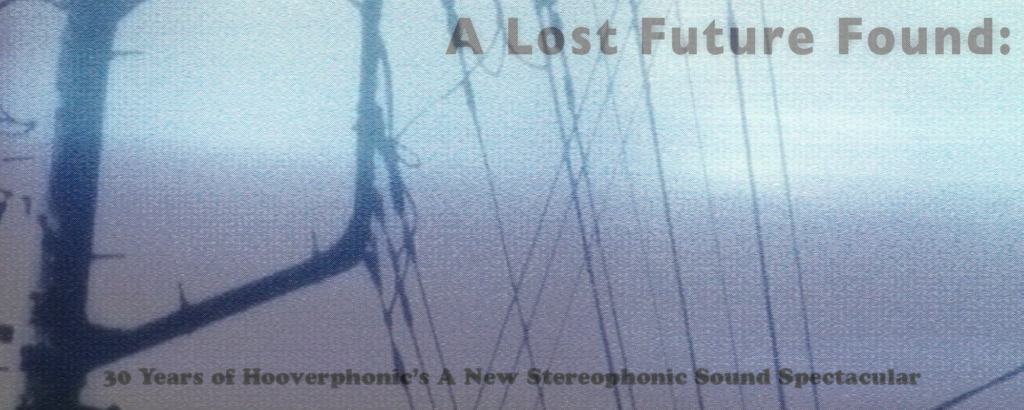
Design by Sophie Parrish
By jean robert delos santos
Hooverphonic’s first album, A New Stereophonic Sound Spectacular, is a bit of an outlier in classic trip hop. Unlike all the classic trip hop albums we have from the likes of Massive Attack and Portishead, Hooverphonic takes in influences from shoegaze, giving it a strange dreamlike feeling. This feeling isn’t nostalgia to me; it’s something much stranger and weirder. Mark Fisher wrote a couple of times about what he called “Lost Futures,” those futures we thought of in the past that never came to fruition: the aesthetics of cyberpunk, the flying cars of early science fiction, etc. And a lot of trip hop does feel this way, including Massive Attack’s Mezzanine, giving us, in 2026, something that could have been, something that was lost—that we haven’t heard from in years and could only glimpse in something like Lana Del Rey’s song, “A&W.” The feeling I get from Sound Spectacular though, is something much different. It’s not a future lost, or never began, no, when I listen to the album, I am listening to something happening at the moment, as if, despite coming out 30 years ago, in 1996, it still feels of our time. It seems like we have never left the soundscape of the album; it seems as if, out of all the futures lost in the 20th century, one has made its way. And what is more strange to me is the fact that despite this world being the only one to come to fruition, it is the one that is least talked about or listened to in terms of hip hop; but that may speak more to our fear, our lingering for nostalgia than embracing the present and driving forth to the future.
The state that this album invokes is a half-dreaming, half-waking state. You know that sensation, when you wake up after a dream that should mean something clear, that you get is trying to tell you something, but you can’t just figure it out. And you just lie there, looking up at the ceiling trying to get at those lost details that must hold some key to the rest of your life? That’s the sensation of Sound Spectacular. And perhaps my metaphor would make more sense if we consider the ’90s as a whole: it was a time of lethargy for the West, but there was the sense of something about to happen, reflected in some of the more aggressive music at the time such as Nirvana or Nine Inch Nails. An apprehension: the end of the millenium, the potentiality of the technological, particularly internet, boom, whether it will bring hell or heaven. Adam Curtis in his 2016 documentary, HyperNormalisation, has a whole sequence of American disaster films showing national monuments and whole cities being destroyed. During the sequence, a clip from Armageddon (1998), shows a chilling sequence of people falling off a tall building to avoid a meteor hurtling towards it—all the films featured predate 9/11. And perhaps this anticipation extends over to Europe with the aftermath of the Years of Lead in Italy, Margaret Thatcher in London, the fall of the Berlin Wall in 1989. How those events brought out new hauntings.
One song stands out the most in Sound Spectacular, and that song is “Nr. 9.” I always felt attached to this song because I feel it encapsulates this fin de millénaire feeling. The song itself is one of the more shoegaze-influenced songs, but it still carries what Tricky titled his album of the same year: the Pre-Millennium Tension. The song is blue and has a sense of futurism; it starts right away with a sudden burst of guitar before going soft, into that half-dream territory. It is not hard to draw a line between this song and the dream sequences in The Sopranos (a show also heavily affected by 9/11), specifically Tony’s infamous fever dream. “Nr. 9,” to me, holds the shifting tensions in the human spirit at the turn of the millennium.
In its relation to the genre of trip hop as a whole and Sound Spectacular itself , film noir comes to mind. Like trip hop, it is a genre to which a lot of movies today are indebted. But most films of that era, other than a select few, are practically forgotten. Like trip hop, film noir is a world in flux, a world where time is dissolute and events unreliable. Like trip hop, there is a tension with technology, an uncertainty in what new technologies are capable of—think the use of the recorder in Double Indemnity (1944), where the main character draws out his confession. The album cover for Sound Spectacular shows a plane, mid-landing, blurred, flying above runway approach poles. High-speed but slowed down, a place in flux, a territory for tension. “Nr. 9” itself seems like a world slowed down mid-flight, or mid-crash.
Perhaps noir is the perfect landscape for trip hop. It is just as fitting for Hooverphonic’s Sound Spectacular as Massive Attack’s 1998 Mezzanine or Portishead’s 1994 Dummy. Culture was leaving the paranoid dreamlike landscape of the Cold War for the technological boom and early rise of the internet in the ’90s and early 2000s—it was bound to bring up ghosts. And what makes Sound Spectacular different from all the other classic trip hop albums is how haunted it seems. Something as apparent in the sound as the lyrics. “Nr. 9” talks about a girl, maybe the protagonist of the song, maybe another girl on the singer’s mind. The singer is Liesje Sadonius and her voice is quite similar to Katie Jane Garside, a voice that manages to be both vulnerable and powerful, something which for a lot of vocalists, is hard to achieve. She sings this: “Saw her first few months ago/ spacing in Vienna/ undersea cargo.” Later on, the protagonist of the song sings that she saw the girl in a mirror, that she saw her spacing in Vienna. The girl’s identity is ambiguous, it could be the protagonist herself, or another girl. The girl in the mirror could be real or a ghost. The same ghost we see when we look at the mirror everyday. You get the feeling yourself, looking into the mirror. You, everyday, going through life with another self dead inside you, haunting you.
The fact that this album came from Belgium doesn’t seem to be a coincidence. By the time the ’80s came around, Belgium had been plagued by the uncanny and unknown. From 1982 to 1985, a string of murders dubbed the Brabant Killings plagued the province of Brabant. To this day, the killings have remained unsolved. The only thing left is a set of police sketches of strange faces as if they came from a dream—not unlike the uncanny faces Gen-Z are so obsessed with, that litter our nostalgia for analog horror. Conspiracy theories have been built on the killings, with said killers being connected to anti-terror death squads and right-wing extremists. A web with no center. A network of different groups colliding with each other, mixing the corruption of the country and the incompetence of the police force. The same goes for the Dutroux affair. During the ’70s, Belgium also suffered serial abductions and killings, all charged under the name Marc Dutroux, who was officially convicted in 1996. The same paranoid web of elite corruption and abuse existed around him then—and our world now. Belgium, by the ’90s, was a haunted country. Haunted by the past, by history and the Cold War. Was the dream of the new millenium enough to exorcise it? Judging by the sound of Hooverphonic, both in the sense of its creation and how it brings us to the present, it wasn’t. Those same ghosts that haunt us all as a generation; those same ghosts that we try to chase or tamper down through the shiny veil of nostalgia. It’s that dream we had of a childhood that never existed in the first place: as we were dreaming in our suburbia, with our toys, playgrounds, and malls, the world was plagued with wars and terrorist attacks, the death toll piled up and is still piling up today. Sooner or later, the past will catch up to us, and it will bite back. We will rue what we wished for.
Despite a certain bleakness, “Nr. 9,” to me, is also a hopeful song. A song that reminds me that the past has never left, but is always with us, even as a ghost, those lost lovers, those past selves that haunt you. That these ghosts are not there to retreat to, but to learn from. It is a reminder that things can be different, that we don’t have to remain stuck doing the same old things, the same old routine. That you can be a better person than you are now. It is a reminder that a better world is possible. Because, as the song insists, that ghost hasn’t left us yet; one can build history on it.