
Annie Saw The Future
Every Sunday, milk crate revisits an iconic piece of music history—artist, album, or otherwise—as a part of our weekly crate digging series.
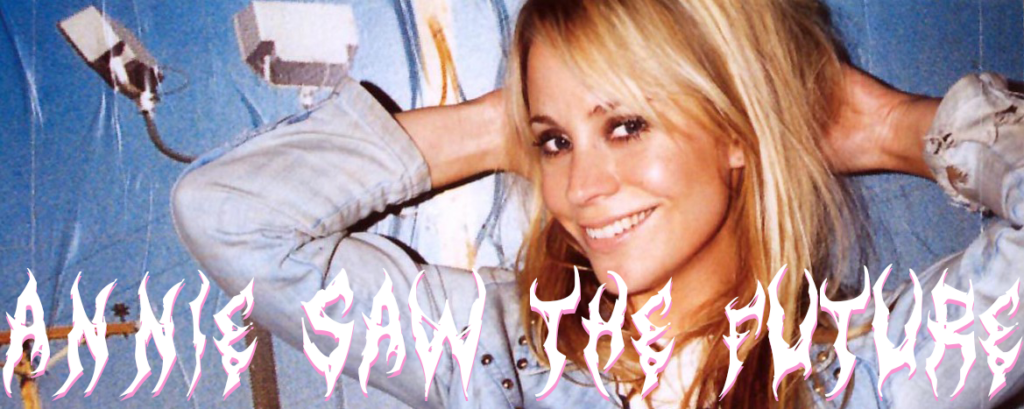
Design By Bennett Himmel
By Bennett Himmel
With all the love it gets these days, it’s surprising to remember that pop, as a genre, has long had to fight for respect in critic circles. It’s seen as bottom-of-the-barrel slop better suited for dancing than thinking. Someone like Britney Spears wasn’t seen as an artist, but rather a vessel for Swedish producers and record label heads to maximize profits and win over people who had recently gained the financial stability to pick their own music. Even if pop music had won over the mainstream, the indie world still saw it as pure slop. Publications such as Pitchfork wouldn’t even justify many pop artists’ reviews; it was a product, not a genre. That was, of course, until a little-known Norwegian pop auteur came onto the scene.
Annie Strand has a pretty similar story to many artists: she comes from rather humble beginnings, singing in choirs growing up and playing in a short-lived band as a teenager. In her 20s, Annie began to DJ around her hometown of Bergen, Norway and met an underground house producer named Tore Kroknes. The two began to date and made a song for fun together. “Greatest Hit,” built off a sample of Madonna’s “Everybody,” stands completely on its own as a bizarro, chilled out piece of synth-pop. Annie is not the most technically gifted vocalist, but the airiness of her vocals lends itself perfectly to this after-hours house-pop. “Keep it coming baby, can you dig it?” Annie sighs. Her slight Norwegian accent and ability to convey emotion make this track irresistible, and the song became a pretty respectable club hit in Europe. The song got Annie some label attention, and she and Kroknes began work on a second single called “I Will Go On.” Then disaster struck.
Kroknes passed away in 2001 from a heart defect. Annie grieved heavily during this time, not making much music, even considering leaving it all behind. In an interview, Annie said, “I was so depressed I just wasn’t able to do anything. I stayed at home, away from everyone, completely in my own world. I wanted to make the album with Tore—that was the plan. After he died I just didn’t think I had the heart. But then I thought, ‘Right, you’re really depressed now but you have to make this album. Tore would be quite pissed off if you just stopped doing anything.’”
The album that did materialize, 2004’s Anniemal, produced mostly by Timo Kaukolampi, Röyksopp, and Richard X, is one of the most forward-thinking pop records of its time. Through a mix of bubbly ’80s chords, noisy synth-bass, and sticky minor-key melodies, Annie envisioned a version of pop music that was mature, sexy, self-assured, and smart. The beat of the lead single, the Richard-X-produced “Chewing Gum” sounds like a ringtone; it beeps and boops and pops with no real rhyme or reason, while Annie’s vocal line gives the effect of a schoolyard chant. “Oh NO! Oh NO! You got it all wrong/ You think you’re chocolate when you’re chewwwing GUM!” she chirps, and the effect is immediately magnetizing. It’s very representative of the songwriting all over Anniemal. It brushes up against the line of nonsensical, but still remains emotionally resonant.
The other Richard X track, “Me Plus One,” is also an absolute delight. It’s clearly inspired by early Madonna, with yet another intoxicating hook. The song, penned by X and Hannah Robinson, is rumored to be a diss towards former Spice Girl Geri Halliwell. As the story goes, for her solo album, Halliwell wanted another Richard X track called “Some Girls,” (which is incredible and would later go on to be released by Rachel Stevens) but was repeatedly turned down. “I think you’ll find the song is me plus one,” she wrote in a letter to X. It got to a point where she allegedly locked herself in Richard X’s car, demanding she get the song. “Take a look at yourself/ Get out of the car/ Can’t you see it’s gone on long enough?/ It’s done,” Annie intones on the track’s bridge. It’s a brilliant pop song loaded with fun turns of phrase, best suited for hairbrush-in-hand mirror performances.
The album’s emotional centerpiece is “Heartbeat,” which is a love song, a party song, and an introspective song all at once. It’s a heartbreaking tribute to Kroknes. “There was a time/ Everybody was around and I was dancing with youuuuu…” she sings, dropping conventional meter and slipping into a conversational rhythm. The track has a bunch of different phases, going from ballad to disco to airy dance-pop and back again. Over just three minutes, the song mutates like Annie’s phases of grief. It’s catchy and heartbreaking at the same time. It completely paved the way for dance-pop mixed with melancholy, like Carly Rae Jepsen’s Dedicated or Brat or the entire second leg of Robyn’s career. It approaches perfection. Pitchfork even had a change of heart(beat) about pop music; they called it their song of the year.
Anniemal, as a whole, was welcomed with open arms by the indie scene and music critics alike. Through sheer word of mouth, dance-pop had suddenly earned a seat at the table in indie music. With tracks that commented on class, like the title track, or freaky, slinky breakup songs like “Always Too Late,” Annie reshaped a genre that was at times campy or cheesy into something undeniably cool. They weren’t songs about huge emotions, or parties for the end of the world, but rather songs about life. Friendships and nights out and one night stands, and I guess manic Spice Girls. It could be argued that, without Anniemal, dance-pop may never have gotten the respect it deserves. Despite its obvious genius, Anniemal was not a commercial hit overseas, and only a modest hit in Europe. Off of all the critical acclaim, Annie went on to sign an incredibly shitty record deal with Island Records in the USA, resulting in a 6-year delay for her sophomore album Don’t Stop. That record was good, if not as immediately brilliant as Anniemal. It was then over 10 years before Annie would release her most recent record, the David Lynch and Lana Del Rey-indebted Dark Hearts. It’s unfortunate to see how little love Anniemal gets these days though. Pop today couldn’t have happened without it.