
Live at Carnegie Hall is Really, Really, Really Good
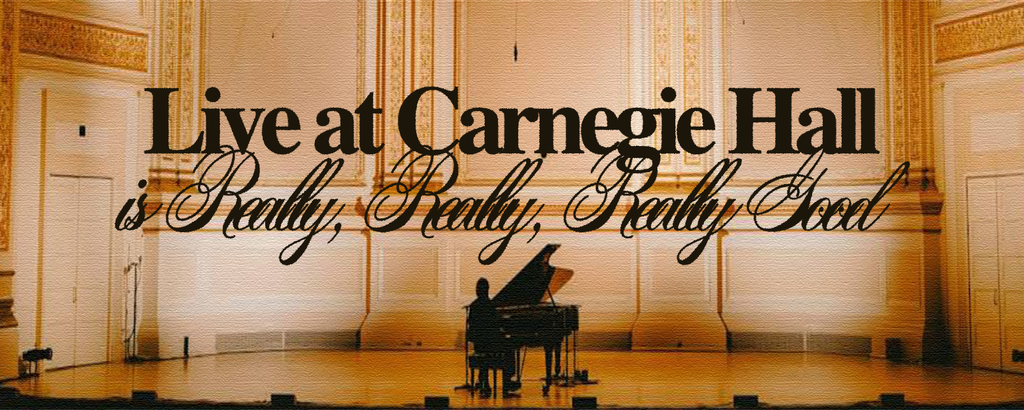
Design by Sophie Parrish
By Declan Ireland
I struggle to categorize Cameron Winter: struggle to fit him onto playlists, to resist the urge to skip when he appears in my cue–sometimes I struggle to even listen to him at all, not for any lack of appreciation for the music, but rather because of the paralyzing sensation one experiences when brought face to face with true greatness. When I am done with a listening session my only recourse to deal with the enormous wellspring of admiration and (if I’m being honest with myself) overwhelming envy that Winter elicits is to either take a long, long walk or create something myself.
Live at Carnegie Hall is the same, and yet, cuts to the quick in another way I can’t quite describe. Where Winter once had whispered he belts and where he waffled he sings. It’s incredible how Winter and company have managed to completely transform those painfully familiar tracks. The layers of static and obfuscation which coat the base work are stripped back to reveal the sheer bulk of skill and talent Winter has maintained and developed since his first foray into public creation on Projector with Geese in 2021, putting any overwrought psy-op rumors to bed for good, at least in this critic’s opinion.
Still, Live at Carnegie Hall seems so empty at first glance. Nothing but Winter’s voice, a Steinway Grand Piano, and the raucous applause of a full house in New York City circa December 2025. Yet it is in this vacancy that Winter is most actualized, bringing home all the Bob Dylan/Leonard Cohen/Johnathan Richman comparisons which many listeners have already grown more than sick of. Just as Dylan/Cohen/Richman did, Winter includes only what he requires, opting for a minimal approach exhibiting a faith in process which is a testament to a life spent enmeshed with the work of making music and all that it entails. It takes great effort and a steady hand to finally accept that sometimes less is more and to allow oneself to grow soft: to omit ego and position oneself not as some musical auteur or lyrical genius, but rather as a conduit through which energy and inspiration and sheer music itself may flow. This labor has borne many fruits, one of the most prominent being that artist and audiences alike are allowed to bear witness to how songs may be completely changed simply by letting them wander where they will. “Nina/Field of Cops” is perhaps the best example of this exploration. Where once the track was overwhelming, hammering frantic strings and piano into one’s skull, on Live at Carnegie Hall it is airy–uplifting, even, seeming less like the worst part of a dark night and more like a bustling mid-morning, albeit one that still foreshadows a long, long day ahead. So too is “Try as I May” made painfully cogent when flowing melodies supplant stilted drum machines, transformed from something hackneyed and ugly (in its own, somehow still beautiful way) into a delicate ode where Winter and his instrument work in collaboration rather than bashing up against one another. So too is “The Rolling Stones” made listenable: an unnecessary and hyperbolic dig, perhaps, but anyone who has listened to the record will be able to tell you how one of the most transcendent moments of its runtime appears in the latter half of what, at least in my opinion, had been Heavy Metal’s most unassuming and least interesting track. The words are the same, and yet, everything is new.
The non-Heavy Metal tracks which were once only available via bootleg or through the paywall of a 200 dollar resale ticket to one of Winter’s shows are now given up freely and in staggering detail. “It All Fell in the River” renders acceptance and sadness in a traditionally Winter-esque style, elusive images of rocks and bells and ribs painting a portrait all too familiar and yet inevitably fleeting. “Emperor XIII in Shades” portrays a hungover morning for the god-fearing juxtaposed with old pastoral images not seen in full force since 3D Country, almost (though not quite) a return to form for Winter’s poetics. “If You Turn Back Now,” however, is by far the highest peak to which the album climbs. There is a pronounced power in the lyrics and their clarity. The few scant times Winter seems to wish to actually say something he intends to do it right. The simple chords swirl about Winter’s voice like a pile of windswept dead leaves. The words seem far away and yet painfully close. “If you turn back now I might just watch you go. My heart is for those who leave me alone.” You can almost feel the desperation oozing through the speakerphones. In my mind Winter’s fundamental conceit as a songwriter has always been, “if I can’t understand myself, why should you get to?” This thesis most frequently comes in the form of lyrics which at first glance make absolutely no sense (as Winter’s dissenters are often apt to discuss) but it is songs like this one that are proof there is a method to the madness. A simple, fundamental contradiction which can be summed up succinctly as nothing more than “the grass is always greener,” is here brought to full form in the devastating realization that loving only what one lacks will yield a long, pitiful life spent chasing shadows and lost in yearning. A hard truth nestled within a shell of resonant glory served to audiences on a silver platter: Cameron Winter at his absolute best.
And all of it coming to theatres near you! It is one thing to hear Winter’s burning voice and quiet keys but to get to witness the paroxysms semi-firsthand is sure to be the most impactful musical experience of 2026 bar none. The concert film which is the record’s pair will be coming to the Coolidge Corner Theater between December 8th and December 10th. A meteor could crash to Earth; aliens could invade or the ground beneath my feet could crack, releasing plumes of magma which burn flesh from bone and I would still find a way to make it to that screening. I will be there: likely weeping, probably in hysterics. I sincerely hope many of you will be there too. Winter’s production cycle in its infancy is so tenuous and Geese’s pace so frantic this might be many’s only chance to witness the artist’s music performed almost live, let alone shot by Paul Thomas Anderson hot off the heels of One Battle After Another and projected onto a silver screen in cool, incandescent light. Live at Carnegie Hall is a gift, and one not to be taken lightly at that. If you haven’t already, I implore you all to go and enjoy it while you can. You never know when a talent like this might be gone.