
Paavoharju, Yhä Hämärää, and the Enticing Charm of the Unknown and the Unseen
Every Sunday, milk crate revisits an iconic piece of music history—artist, album, or otherwise—as a part of our weekly crate digging series.
Design by Diego Gonzalez
By Lucca Swain
Trudging through the snow, blasted by the frigid winter air, caught by the unknown. Until, in the cold grey dark of winter, there rings out a single note, high and long, a phantom’s wail dissipating off into the snowy night sky like a swan migrating southwards. And in an instant, it’s gone, snuffed out by the falling snow and encroaching darkness. Where did it go? Where did it come from? Maybe it doesn’t matter. The world functions in strange ways; there are things we may never understand, and yet, they exist all around us in spite of our inability to know them wholly or even partly. And perhaps one of the only groups to ever really fully understand that idea and successfully capture it in musical form is Paavoharju, the Finnish musical collective whose 2005 debut, Yhä Hämärää, still stands as one of the oddest, most singular musical works to emerge from the Nordic countries in the past twenty or so years.
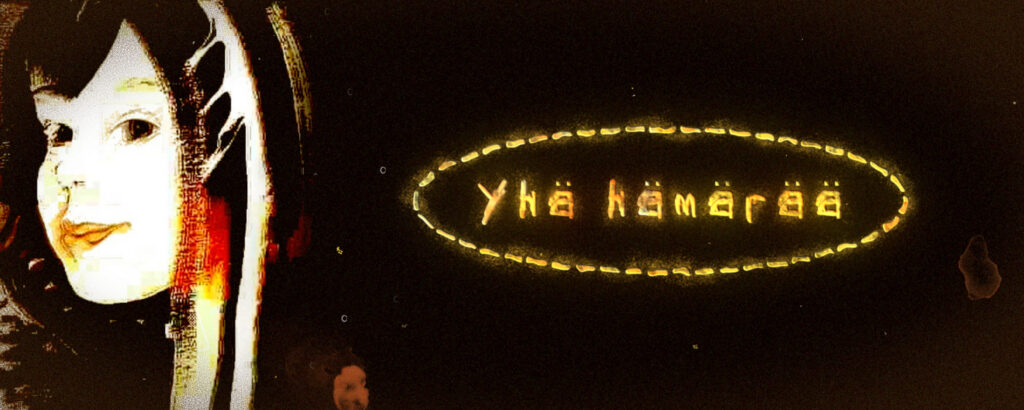
To call Paavoharju “enigmatic” would be a bit of an understatement; nearly the entirety of the group’s career, from the release of Yhä Hämärää through to their 2023 break-up, seemed founded on a refusal to conform to any notion of not only what would be deemed normal, but rational, as well. Everything about the Savonlinna-born group’s ethos and aesthetic is drawn from the esoteric, from their uncanny, unexplainable album covers to the magical, free-form quality of their music, which can veer from weightless ambient ballads to chip-tuned psychedelic folk to full-on electronic club-thumpers with minimal downtime. The group often sounds like they’re tethered between this reality and the next, making music that appeals as much faeries as it does to regular human beings — not to mention that nearly every picture of the band looks like it could have — or may have — been taken in a dilapidated woodshed in the dead-center of Lapland.
Even the band’s mythos, that they were a group of ascetic born-again Christians spawned from founding member Lauri Ainala’s toying with various sounds (“the buzzing of a wasp in a matchbox”) in combination with sequencing softwares while living in abandoned houses across Savonlinna, seems almost too in character to be true (the born-again Christian bit actually turned out to only be half-true). Yhä Hämärää is, more than anything, so notable because it is just so very Finnish — regardless of the veracity of any of the group’s background, the very idea of a forest-dwelling hermit collective making mystical songs for faeries seems to embody many a cultural notion about the Nordic nation and its distinct place among its neighbors. Their music is one that feels like it emerged naturally from the dark heart of the fells, an ancient deep magic that crawled out of the Finnish woodlands and found itself materialized in song by a group of young rascals with a penchant for the opaque and the unknown.
If anything, that deep mysticism being so essential to the band’s sound means that Paavoharju’s music, and in turn Yhä Hämärää, is very much a love-it-or-hate-it affair. Immediately upon the album’s opening, the five-minute ambient piece “Ikuisuuden maailma” acts as the winding off-road through which only willing listeners will navigate, an unmistakably Finnish way of warning about the icy terra incognita beyond — beginning from a faint whisper, it ramps up until reaching a dynamic peak that sounds not unlike a snowstorm blowing in your ears at maximum capacity, as if you’re out there in the cold with them. To any enthusiastic participant in Paavoharju’s otherworldly game, it sounds positively lovely. Though it’s only the mood-setter before kicking off into one of the band’s signature tunes in the form of “Valo tikhuu kaiken läpi,” a track that seems to almost function as a microcosm of Paavoharju style and methodology: an acoustic piece set to a shuffling, distorted programmed drum beat, at times swallowed up by billowing waves of psychedelic synths, and eventually joined with a ramshackle MIDI melody that sounds like it would be right at home in an early Pokémon game. The cacophony of disparate noises certainly creates a disorienting effect, as though you’ve walked in on the world’s weirdest pagan ritual and are now facing the consequences of facing something you shouldn’t have seen and shouldn’t understand.
But there’s also a real beauty to the music on Yhä Hämärää that reveals itself over time, as buried beneath the layers of disconcerting MIDI sound bites and distorted vocals is a childlike wonder with an almost possessive power. Paavoharju imbues their songs with such an intense amount of childish wonder that it’s easy to get the gist of what they’re going for even if you don’t speak a lick of Finnish (I don’t). Every successive listen becomes like opening up a toybox to discover new feelings, new ways of reconfiguring what the music can be and where it can take you; like wandering through the forest as a wee child and discovering that the world is so much bigger than you ever possibly thought it could be. The overwhelming mystery of the music, the thought of what is this and where did it come from? is enticing like nothing else, enough to draw you back again and again even as the sounds themselves puzzle; tracks like the kaleidoscopic “Syvyys,” a bluesy, lo-fi guitar ballad abetted by ghostly vocals and offbeat sample manipulation, play like a campfire to huddle around before being plunged inevitably back into the darkness, though, before long, even the darkness reveals its beauty. The fantastical paean “Musta Katu” is almost definitely the album’s strongest track, a sudden switch to straightforward pop structure where the rest of Yhä Hämärää lingers in ambience and atmosphere. Despite the radical vibe change, it’s absolutely effervescent, as well as deviously catchy, a jaunt for joy so full of life it practically asks for you to get up and move around with it. Like the best of Paavoharju’s music, it works because they understand that beauty can’t exist without melancholy; the gorgeous sunrise of “Musta Katu” can only exist thanks to the unknowable nighttime that precedes it.