
Still All Fucked Up: 20 Years of Eiafuawn’s Birds in the Ground
Every Sunday, milk crate revisits an iconic piece of music history—artist, album, or otherwise—as a part of our weekly crate digging series.
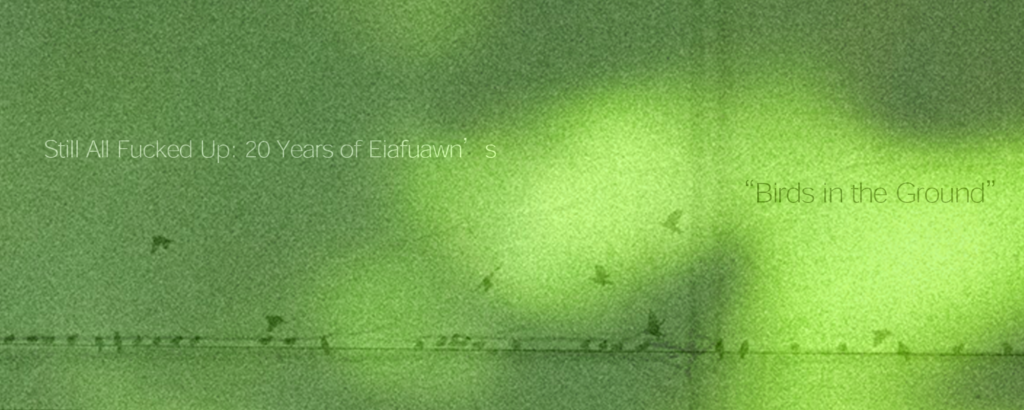
Design by Sophie Parrish
By Julia Schramm
On February 24, 2006, Clay Parton slinked away from the shadow of his then inactive slowcore band Duster, and, under the now-defunct record label The Static Cult Label, released Birds in the Ground. Operating under the name Eiafuawn (pronounced ee-uh-fon), an acronym for “Everything is all fucked up and whatnot,” Parton found solace in the slacker-rock project, which he recorded over the course of multiple years, alone in his home.
This album found me at the beginning of my sophomore year of high school, after I spent my freshman year crying to and obsessing over Duster with my friends. After a while, I was doing better mentally, and Duster’s gloomy drone was no longer as fitting for my everyday routine. But early teenage malaise and the northeastern cold still called for some slow mopery. The school hallways still felt too bright, the mornings too early. I needed something that held onto sadness without letting it completely swallow me. Birds in the Ground filled this requirement perfectly.
Birds in the Ground is quite short, and its miniature runtime of only 37 minutes and 22 seconds teems with typical slacker-rock lo-fi fuzz and apathy-laced vocals. The album presents the same slow, shy sadness as Duster—though not as muted as Stratosphere (1998), instead more reminiscent of songs off of Contemporary Memory (2000), such as “Cooking” and “Unrecovery.” Through its brief length and plain yet poetic lyrics, Eiafuawn expresses a simple authenticity that is seldom done so well, and it makes you feel close to every track, each intimate in their own way. When I found the project, it was that closeness that mattered most to me; that perfect middle ground between sadness and awareness. I didn’t want to give myself up to my sadness, but I didn’t want to avoid it, either. I wasn’t looking to dissolve away into an endless drone, I just wanted to sit with my thoughts in a little momentary layer of fuzz.
The album opens with “Bunny,” the subtle hiss of Parton’s 4-track tape haunting the song, along with his whiny vocals and repeated riffs. It was ideal for my melancholic high school introspecting, while effectively setting the tone for the following tracks to come.
The second track, “No More Like That,” stands as the most popular song of the album by far. It’s a short heavy-hitter, just about 2 minutes long. “The Voice of Music” and “Bees” are similar; all are slightly more upbeat tracks rhythmically speaking, but the lyrics don’t reveal much emotion—a mix of small poetic statements and mundane fragments amidst the instrumentals. With nothing spelled out, it was easier to project onto the lyrics, interpreting them like my own half-formed journal entries or late-night thoughts.
“Birds” seems to linger, steadily slowing the album down from its previous rhythm. Drowsy echoed guitar accompanies Parton as he croons the album’s namesake, “There’s bugs on the moon/ There’s fish in the clouds/ There’s birds in the ground/ There’s rocks in my mouth.” The surreal phrases sound silly at first, but they perfectly captured the teenage sense of everything feeling slightly misplaced. The distorted guitar pushes the feeling of separation even further.
Later comes “The Coffin Was So Light I Thought It Might Float Away,” my personal favorite track off the album for both its musicality and lyrics: “My dad has a cigarette case built in his cowboy hat/ But he doesn’t smoke.” The song begins with a sweeter acoustic guitar and takes a turn halfway through as a catchy but distorted riff layers repetitively over the acoustics, an unsettling warning as Parton asks, “When you choose the ones to trust/ do you do it tooth by tooth?” The repeating lyrics that close the track mirrored my own worries looping quietly throughout my classes or walks home.
“Good God Y’all” seems to follow an altered version of this format. The first minute of the song rolls out in punches, each syllable accompanied by sharp twangs until another catchy riff repeats for the last 2 minutes. The album then takes a musical turn with “On a Peoplemover.” Here, Parton’s vocals are distant, almost unreachable and barely audible, echoing on just a few lines throughout the whole song.
The album ends with “Modulator Hustle,” the first track ever released under Parton’s Eiafuawn title. The first 3 minutes of the song sound like musical patheticness, the sound of slipping away. Parton sings: “Different phantoms for different fires/ Be patient/ Hush, hush/ Detach and adjust.” The track and album end with a single hi-hat hit and closed eyes.
Unlike the steady and booming resurgence of Duster within the past years, Eiafuawn has seen little resurrection outside of smaller spaces. On February 25, 2022, archival record label The Numero Group released deluxe pressings of Birds in the Ground, as well as full Spotify and Bandcamp uploads. But the area that Eiafuawn finds itself in doesn’t need to be large, and the album doesn’t need a cultural revival. It only needs to play in quiet bedrooms and turned-up headphones, existing in the personal and authentic world it cultivates for each listener. 20 years later, Eiafuawn stands as a meaningful record of early 2000s slacker artistry—gloomy and detached yet oh so emotional. Maybe in our own interior worlds, everything is still all fucked up, but in Parton’s world of Birds in the Ground, everything is right.