
The Concert of a Lifetime: Revisiting Whitney Houston’s Historic South Africa Concert
Every Sunday, milk crate revisits an iconic piece of music history—artist, album, or otherwise—as a part of our weekly crate digging series.
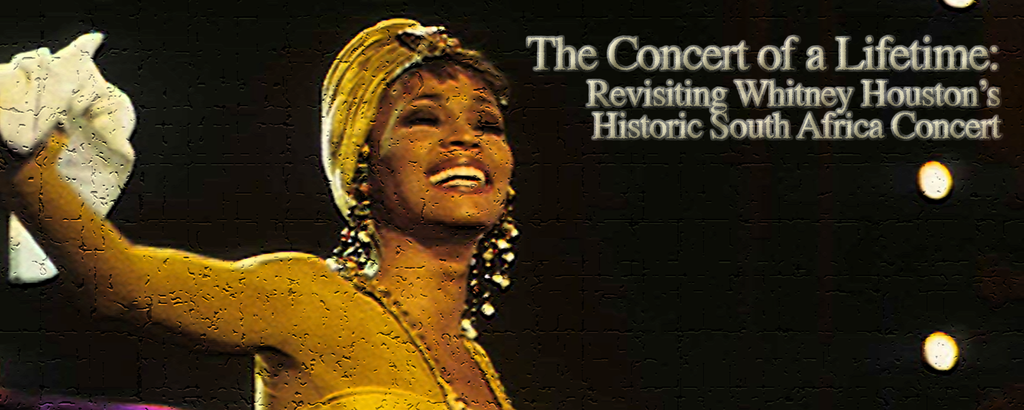
Design by Sophie Parrish
By Andrew Mendes
In 1994, a new South Africa emerged on the global stage. With help from a newly freed Nelson Mendela, a near fifty year white minority rule was lifted. South Africa was no longer racially segregated and Nelson Mendela was elected president. With a newfound freedom in South Africa, Whitney Houston performed a three night concert. During those three nights, Whitney cemented herself on the world stage with her vocal ability. She proved she needed no vocal enhancement in front of a staggering crowd of 200,000 people, and more watching later with its release on HBO. She cemented a legacy of having a once in a lifetime voice. This monumental performance was recorded initially for an HBO special and then hidden away. Thirty years later the album would finally be released. Listening again two years later this album perfectly captures why Whitney is a once in a lifetime artist.
Leading up to 1994, Whitney released three studio albums. The first being her debut titled Whitney Houston 1985, the second Whitney in 1987, and I’m Your Baby Tonight in 1990. These three albums show a growth creatively and vocally. In her first two albums Whitney hones in on what would become her Whitney magic. . The tracklist is composed of songs listeners in 1985 would have been familiar with and new songs that work in the ‘80s pop genre. “How Will I Know” and “I Wanna Dance with Somebody” were originally intended for different artists. If the songs were given to any other artist they could have been remembered simply as one hit wonders. When Whitney got a hold of them, the songs transformed. Her charisma and vocal ability turned her songs into classics. This magic captured the world and people couldn’t get enough.
In 1992, Whitney would play the meta role of Rachel Marron in The Bodyguard. Rachel Marron is an enormous superstar who is navigating fame and a dangerous stalker, sound familiar? The movie saw Kevin Costner playing Whitney’s bodyguard, whom she falls in love with. The movie grossed $411 million dollars but was shadowed by the success of the album. The tracklist lives in infamy but the numbers describe it better. 45 million copies were sold, with 1 million in the first week. “I Will Always Love You” sat at number one for 14 consecutive weeks. The album won album of the year at the 1994 Grammys and it’s clear to understand why. It wasn’t the Dolly Parton or the Chaka Khan cover. This talent Whitney exhibited in her first three albums came to a head on The Bodyguard. Movie watchers were situated in Whitney’s world. A world in which can be hard to grasp but none the less can be made empathetic. The songs chosen reflected Whitney’s life and the listeners could connect her reality with particular songs. She was no longer singing commercial hits; the songs were personal and her singing carried that truth. With all this success there was only one choice for her: to go on an international tour.
The tour started in 1993 and Whitney performed a total of 120 shows. The concert concluded in 1994 with three nights spent in Durban, Johannesburg, and Cape Town. The concerts followed the same formula: her endless parade of hits, classics from legendary artists, and her signature songs. The classics for her South Africa concert were “Master Blaster” by Stevie Wonder and “Home” from The Wiz. Covering Stevie Wonder is no small challenge for any artist, most cower at the chance or don’t live up to it. Whitney was different. Her magic is making any song her own. Going back to her roots, the songs she covers aren’t just any, they mean something to her. Her meaning is conveyed in her voice. Whitney holds her own when it comes to the greats of music. Her true magnum opus was her cover of “Home.” The song was originally written for The Wiz and is sung when Dorothy realizes she wants to return to Harlem. Prior to Whitney’s version, Stephaine Mills and Diana Ross had sung the song. It was a hit then but Whitney conveyed the emotional meaning of the song through singing. Most singers give their all towards the end as the song allows for a singer to belt. A reminder of a singer’s vocal capacity. Whitney knows that she doesn’t need to let you know she can sing. Rather, she wants you to know why she connected with the song.
Before singing she remarks “I have finally come home to my people.” Whitney chose this song as an expression of her pride of being Black. Looking at her setlist, she takes the listener on a journey. Halfway through her performance the emotions come to the forefront. The beat gets faster and Whitney’s vocals don’t waver. Her emotions grow in intensity with her voice. She isn’t running a marathon to get to the end to simply belt out. She guides you through the song. She wants you to feel a lyric and hold that pause. Being in a unified South Africa, Whitney was home.
Whitney had a way of making her classics untouchable. How does one sing “I Will Always Love You” or “I Have Nothing?” It’s a bold statement but verified by her version on the album. It’s hard to put the tenderness of “I Will Always Love You” into words. That’s why singing it is best. Its magic lies in how Whitney wraps you in it. Listening to her perform, the audience is waiting on her next melody and that energy is felt on the recording. Just like her other songs, she guides the listener through the emotional intensity. The classic acapella to the chorus to that note. When coming down from the legendary C#5 Whitney holds for the subsequent notes, the audience holds their applause for each. She waits for the audience to want that note and delivers it to them. It defies the power balance most artists have while performing. It’s not Whitney dictating the performance, it’s the crowd. Somehow Whitney still holds the power. The same dynamic is applied in “I Have Nothing.” Instead of having a signature note she has a signature style, putting emphasis on the word and letting the audience feel its emotional baggage. Left in suspense, the audience knows what will come next but are left in anticipation. The song is deeply personal as it reflects a person telling the one they love they have nothing without them. Whitney didn’t have many people to turn to at this stage in her life. Her confidants and circle was getting smaller. Her truths couldn’t be spoken about so they were reflected in her songs. Singing took on a new meaning. Her secrets were told in song and her listeners were her confidants. The evening concluded with saxophonist Kirk Whalum performing “I Will Always Love You.” Whitney moved the microphone to her side, told the crowd she loved them and gestured that she was spreading her love to the audience. She ended her time on stage by putting one leg over the other and curtseying.
The years following this performance would be tumultuous. Whitney would face rampant drug use, rumors of a lesbian relationship, public familial drama, a tumultuous divorce and that fateful afternoon in LA. As you listen, don’t think of what is to come but rather what is. This album and these performances remind us why she is “The Voice.” Her vocals are live and untouched. Simply put, one can only get this vocal ability from God. Her range was unmatched and unduplicated; no producer or soundboard could match what Whitney was capable of. Don’t think of her as a Billie Holiday but rather a once in a lifetime talent. Many aspire to achieve it, yet none have it.